How to Use AI Ethically as a Student: 10 Practical Rules
Artificial Intelligence (AI) is no longer a futuristic concept for students.
It’s already shaping how you research, study, write, and organize your academic life.
From brainstorming essay ideas to creating personalized study plans, AI tools have proven incredibly helpful.
But with that power comes responsibility!
When AI is used carelessly, the risks include academic integrity violations, over-reliance that weakens critical thinking, biased or inaccurate information, and grave privacy concerns.
Used well, however, AI can become a learning partner rather than a shortcut.
As Stanford AI researcher Dr. Fei-Fei Li puts it, ‘AI doesn’t replace thinking, it augments it.’
This guide breaks down how students can use AI ethically and responsibly.
Drawing on expert perspectives, academic research, and real-world examples, you’ll learn how to use AI ethically as a student, integrating AI into your studies in a way that strengthens your skills.
What “Ethical AI Use” Really Means
Before going any further, it’s important to clarify what ethical AI use actually means in an academic setting.
Ethical AI use isn’t about avoiding AI tools or treating them as off-limits.
Instead, it’s about using them intentionally, with responsibility, and awareness of their impact on learning.
At its core, ethical AI use involves being honest about when and how AI tools are used in academic work.
It requires respecting privacy and consent, both your own and that of others, and being mindful of what data you share with AI platforms.
Ethical use also means verifying AI-generated information with credible, independent sources, rather than treating AI outputs as authoritative or error-free.
Ethical AI use also demands that students avoid plagiarism and misuse.
AI should support understanding, exploration, and skill development, not bypass the thinking process or replace original work.
These principles closely align with guidance from the Markkula Center for Applied Ethics at Santa Clara University, which emphasizes fairness, honesty, accountability, and respect as the foundation of ethical technology use.
These values will serve as a framework throughout this post.
10 Tips on How to Use AI Ethically as a Student
Now, let’s discuss how students can use AI ethically and responsibly:
1. Be Transparent: Always Disclose AI Use
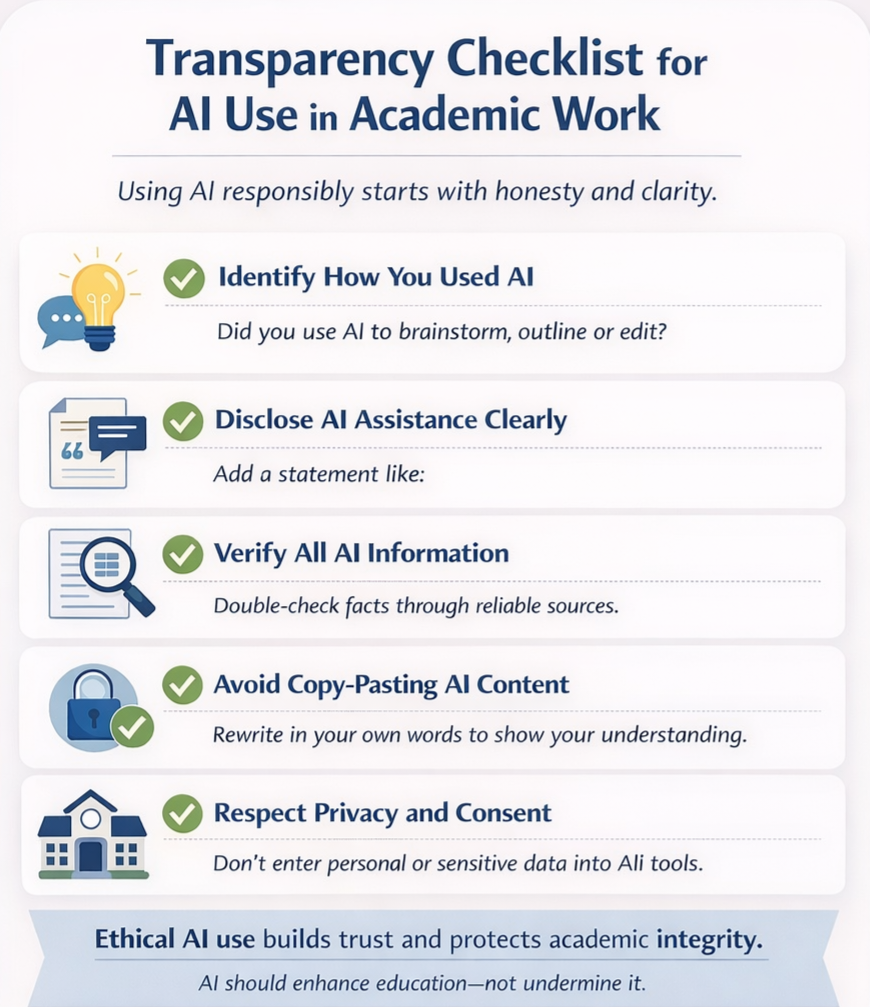
Transparency is the foundation of ethical AI use in academic work.
When students are open about how they use AI tools, they protect their credibility and build trust with instructors and institutions.
Ethical use isn’t just about what AI helps you do, it’s about being honest that it helped at all.
If you use AI to draft, brainstorm ideas, or revise your work, disclosure should be clear and proportional to the role the tool played.
In most cases, this means briefly acknowledging AI assistance in a footnote, acknowledgment section, or submission note.
At a minimum, ethical disclosure should include:
- A clear mention that AI was used
- A short explanation of how it was used (for example, brainstorming ideas or refining structure)
Example disclosure statement:
“This draft was created with support from ChatGPT for brainstorming and structural guidance. All facts, arguments, and sources were independently developed and verified.”
Research also shows that transparency around AI use is necessary—but not simplistic.
A study by Trusting News, which examined how audiences respond to AI disclosures in journalism, found that while people strongly want AI use to be disclosed, trust can decrease when disclosures are vague or poorly explained.
Trust increases when disclosures clearly describe how AI was used and emphasize ongoing human oversight.
The findings suggest that ethical transparency isn’t just about admitting AI was involved—it’s about explaining its role responsibly and thoughtfully.
2. Use AI to Learn — Not to Cheat
AI works best as a learning assistant, not a shortcut.
When used responsibly, it can help students understand complex ideas, study more effectively, and engage more deeply with course material.
A student will cross the ethical line when AI replaces thinking instead of supporting it.
It can be especially useful when you’re stuck or trying to grasp unfamiliar concepts.
For example, help you test your understanding, it can break down difficult topics, or summarize long readings so you can focus on analysis rather than surface-level comprehension.
Ethical learning-focused uses of AI include:
- Asking AI to explain concepts you don’t understand
- Generating practice or self-test questions
- Summarizing readings to support comprehension
Submitting AI-generated essays as your own work or using AI to generate answers during exams or graded assessments crosses into academic misconduct and can carry serious consequences.
A helpful rule of thumb is this: If AI helps you produce text, rewrite it in your words before submitting.
This step ensures you actually understand the material and preserves your original voice.
The International Center for Academic Integrity strongly advises treating AI as a learning partner rather than a shortcut, emphasizing that ethical use should deepen understanding, not bypass effort.
| Responsible Use of AI | Irresponsible Use of AI |
| Using AI to explain difficult concepts | Using AI to complete assignments for submission |
| Brainstorming ideas or outlining structure | Copy-pasting AI-generated text as original work |
| Summarizing readings to aid understanding | Relying on AI without reading the source material |
| Generating practice questions or study guides | Using AI during exams or graded assessments |
| Editing grammar or improving clarity | Allowing AI to replace personal voice and thinking |
| Verifying AI outputs with trusted sources | Submitting unverified or inaccurate AI information |
| Disclosing AI use when required | Hiding or misrepresenting AI involvement |
| Using AI to support learning | Using AI to bypass effort or learning |
3. Respect Intellectual Property
AI tools are trained on vast datasets that may include copyrighted material, which makes intellectual property a key ethical consideration for students.
While AI can help you understand and work with information, it should never be used to reproduce protected content or pass off others’ work as your own.
When using AI, students should be alert to whether an output includes verbatim text from articles, books, or other protected sources.
If AI-generated content closely resembles an existing work, it should be rewritten in your words or properly cited where appropriate.
Asking AI to replicate entire articles, texts, or chapters crosses clear ethical and academic boundaries.
Best practice: Use AI to summarize, synthesize, or explain ideas.
4. Verify AI Information with Real Sources
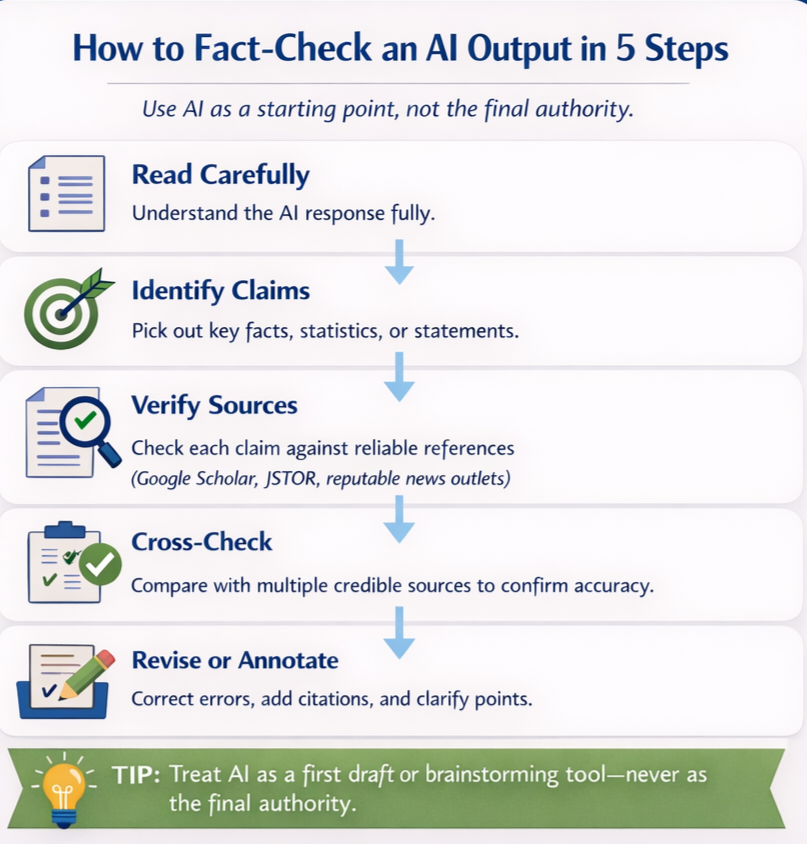
AI tools can sound confident even when they’re wrong.
One of the most common risks of AI use is “hallucination,” where the system generates information that appears plausible but is incomplete, inaccurate, or entirely fabricated.
For this reason, AI outputs should always be treated as a starting point, not a final authority.
Facts, statistics, and claims should be verified using trusted sources such as scholarly databases, reputable news organizations, and academic libraries.
Reliable verification sources include:
- Scholarly databases like Google Scholar
- Library databases such as JSTOR, EBSCOhost, and PubMed
- Established news outlets like the BBC, The New York Times, and NPR
Research also shows that students themselves are acutely aware of AI’s limitations and the need for critical checking.
In a survey conducted by Duke University’s Center for Teaching and Learning, a large majority of students agreed that AI responses can be inaccurate, inconsistent across different subjects, and overly simplified—underscoring why verification and careful evaluation are essential.
Many of those surveyed also recommended that instructors discuss ethical uses of AI and provide clear guidelines to help students use these tools responsibly.
5. Protect Your Privacy — and Others’
Most AI tools collect and store user data, making privacy another crucial ethical concern.
Students should be cautious about what information they share, especially when using AI platforms for academic work.
As a rule, personal or sensitive information should never be entered into AI tools.
This includes private identifiers, login credentials, or the full names of individuals who have not given consent.
Many platforms also share data with third parties, which increases the risk of misuse or exposure.
Avoid entering:
- Personal identification numbers
- Passwords or login details
- Full names or private information about others
Privacy tip: Use AI for general academic tasks and keep personal, identifiable data out of prompts.
For a deeper understanding of privacy risks, the Electronic Frontier Foundation offers extensive guidance on AI and data protection.
6. Cultivate Critical Thinking
Ethical AI use depends on active thinking.
The strongest students treat AI as a thinking partner, one that supports analysis rather than replacing it.
Accepting AI outputs without reflection weakens learning and increases the risk of errors.
After receiving an AI-generated response, it’s important to pause and evaluate it critically.
Ask whether the answer makes sense, where it might fall short, and what credible sources can confirm or challenge it.
This reflective step keeps students in control of their learning.
Also Related: Free Writing Examples for Students to Unlock Creativity.
7. Understand Bias in AI Outputs
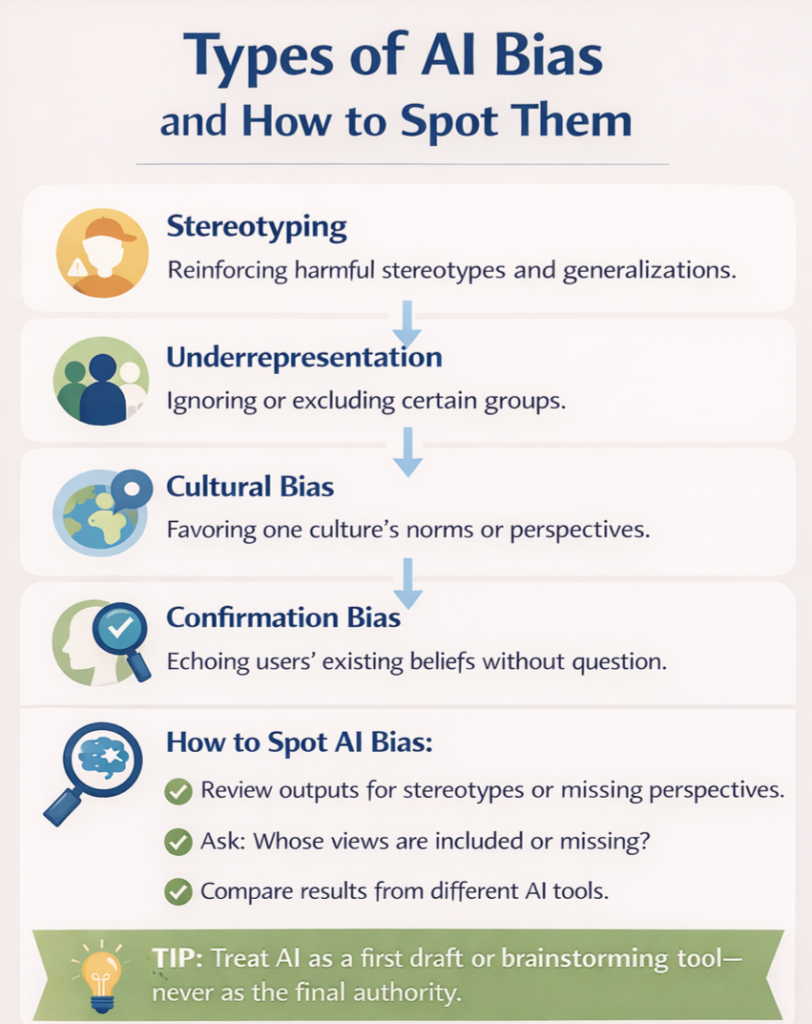
AI systems learn from large datasets that reflect real-world patterns—and real-world biases.
As a result, AI-generated content can unintentionally reinforce stereotypes, exclude certain perspectives, or make cultural assumptions.
Bias may appear subtly, such as through uneven representation of groups, oversimplified narratives, or language that reflects dominant cultural viewpoints.
Ethical AI use requires students to recognize these patterns and actively correct for them.
To reduce bias, students can evaluate outputs for fairness, compare responses across different AI tools, and consult diverse, authoritative sources to balance perspectives.
For a deeper exploration of this issue, UNESCO’s guidance on AI ethics in education provides a valuable global framework.
8. Use AI Tools That Prioritize Safety
Not all AI platforms are created equal when it comes to transparency, privacy, and control.
Choosing tools that allow you to manage your data, present clear terms of service, and disclose their training sources is an essential step in ethical use.
Safe platforms help protect both your work and your personal information while giving you confidence in the AI outputs you rely on.
Some widely used, safety-conscious AI tools include:
- ChatGPT
- Perplexity
- Bard, and
- Elicit (a research assistant designed for academic work).
When selecting a tool, review its privacy settings and terms of service to ensure your data is handled responsibly.
9. Follow School and Institutional Policies
Educational institutions are speedily updating their policies around AI use.
Acceptable use varies by professor, course, and assignment type, so it’s important not to make assumptions.
Ask specific questions such as what AI tools are allowed for drafting or research? How should AI contributions be cited? What constitutes academic misconduct in this context?
Clarifying these points upfront helps you stay in compliance and avoid unintentional breaches of academic integrity.
For guidance, EDUCAUSE provides a helpful overview of institutional AI policies and considerations in higher education.
10. Build Your Own AI Literacy
Ethical AI use is a skill that improves with practice and learning.
Building AI literacy means understanding both the potential and the limitations of these tools.
Students can start by taking free courses on AI and AI ethics, reading research papers regularly, and engaging with campus workshops or clubs focused on emerging technologies.
Some excellent resources for building AI literacy include: MIT AI Ethics and Coursera’s AI For Everyone.
Developing these skills supports ethical AI use and also prepares you to leverage AI effectively in future academic and professional work.
Case Studies: Ethical and Unethical AI Use
Take these case studies for brainstorming purpose only:
Ethical Example
- Scenario: A student uses AI as a brainstorming partner to generate ideas for potential essay themes. They then research, outline, and write the essay independently, integrating the AI-generated ideas thoughtfully. The student also includes a brief acknowledgment of the AI tool in the assignment.
- Outcome: The final essay demonstrates original thinking and strong analytical skills, while transparently crediting the AI tool. This approach models ethical AI use, showing that technology can enhance learning without replacing critical thinking.
Unethical Example
- Scenario: A student takes an entire essay prompt, inputs it into an AI tool, and submits the AI-generated response as their own work, without editing, verification, or acknowledgment.
- Outcome: This leads to a clear academic integrity violation, as the work is no longer the student’s original effort. Beyond potential disciplinary action, the student misses the opportunity to develop critical research and writing skills, highlighting the risks of misusing AI.
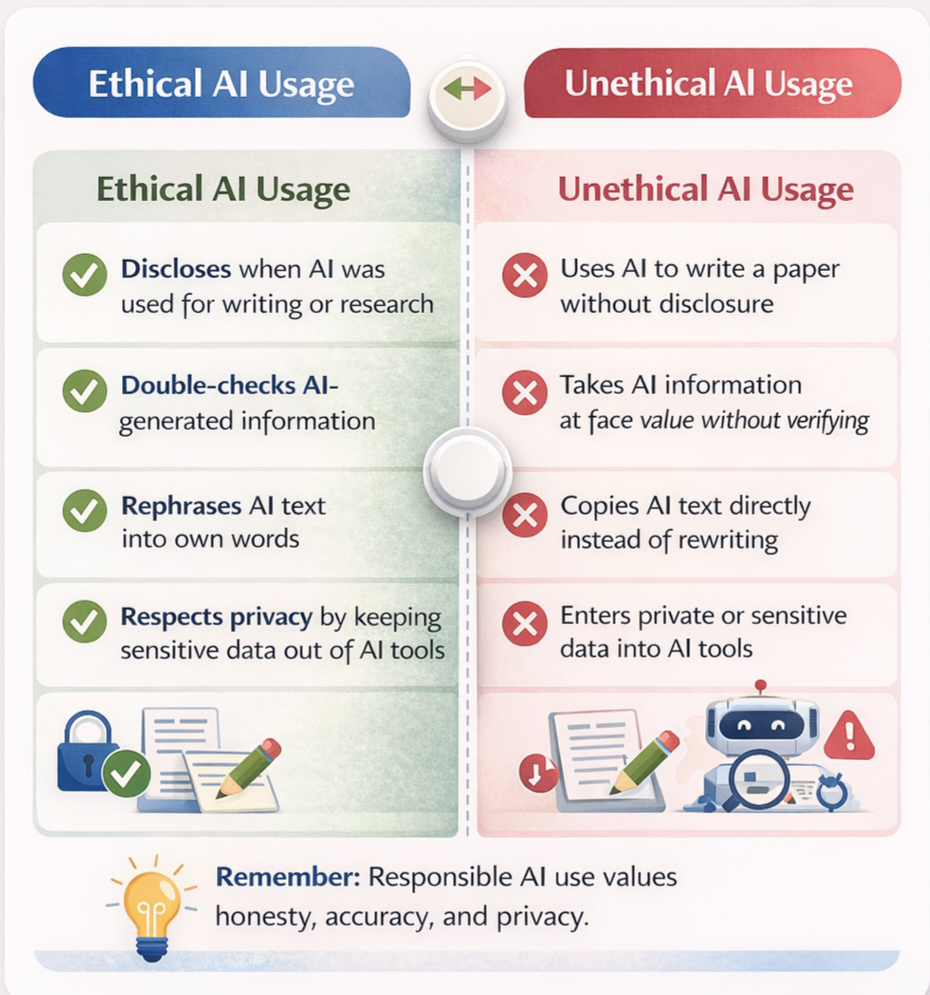
Final Checklist: Ethical AI Use as a Student
Before submitting work, ask these questions:
- Did I disclose AI use?
- Did I verify facts with trusted sources?
- Did I avoid personal or sensitive data?
- Did I respect copyright and privacy?
- Did I learn something, not just get an answer?
What if you don’t know how to write as a student? This article contains quick suggestions and explains why writing is important for students.
Final Thoughts
AI isn’t the future—it’s here, shaping how students research, write, and learn daily.
Using AI ethically isn’t just about following rules; it’s about becoming a smarter, more responsible student who can harness technology to truly enhance understanding.
Regarding what you’ve learned about how to use AI ethically as a student, use the information thoughtfully and with integrity.
When you do, it will set you apart, giving you a real competitive advantage in both academics and beyond.
When you use AI ethically, it becomes a tool that strengthens your learning, deepens your critical thinking, and supports original work, rather than a shortcut that bypasses effort.
The key is to approach AI as a partner.
Always verify its outputs, respect intellectual property, and integrate it into your reasoning and creativity.
By doing so, you ensure that AI is not just a technological convenience, but a powerful ally in your growth as a student.

Isaac
Isaac is a writer and content strategist who helps new and emerging writers turn their stories into income. He focuses on practical writing systems, monetization platforms, and sustainable creativity, especially for beginners navigating modern publishing.
You May Also Like

Short Form Video Script Writing Service: Turn 15 Seconds into Impact

Humorous Writing Examples: 4 Ways to Make Your Readers Laugh